
Classic Eggs Benedict Recipe with Perfect Hollandaise

The moment a poached egg breaks open and the yolk runs down into hollandaise on a toasted English muffin, you understand why eggs benedict has held its place on brunch menus for over a century. It looks indulgent. It tastes indulgent. And it’s built from four components most people already know how to handle individually.
The challenge is always the hollandaise. Get it right and the whole dish clicks into place. This recipe uses a proper double boiler technique that gives you full control over the emulsification, which means a silky, stable sauce rather than a greasy, broken one.
Why You’ll Love This Eggs Benedict
- The hollandaise is made by hand using the double boiler method, which gives you more control than a blender version and a noticeably better texture
- Canadian bacon crisps up in 2 minutes in the same pan, with no extra steps or equipment
- Poached eggs cooked in vinegar water hold their shape cleanly, with set whites and a yolk that runs when you cut into it
- Four components with one coherent timing plan, so nothing sits getting cold while you finish something else
- Scales up naturally from 2 to 8 servings without changing the method
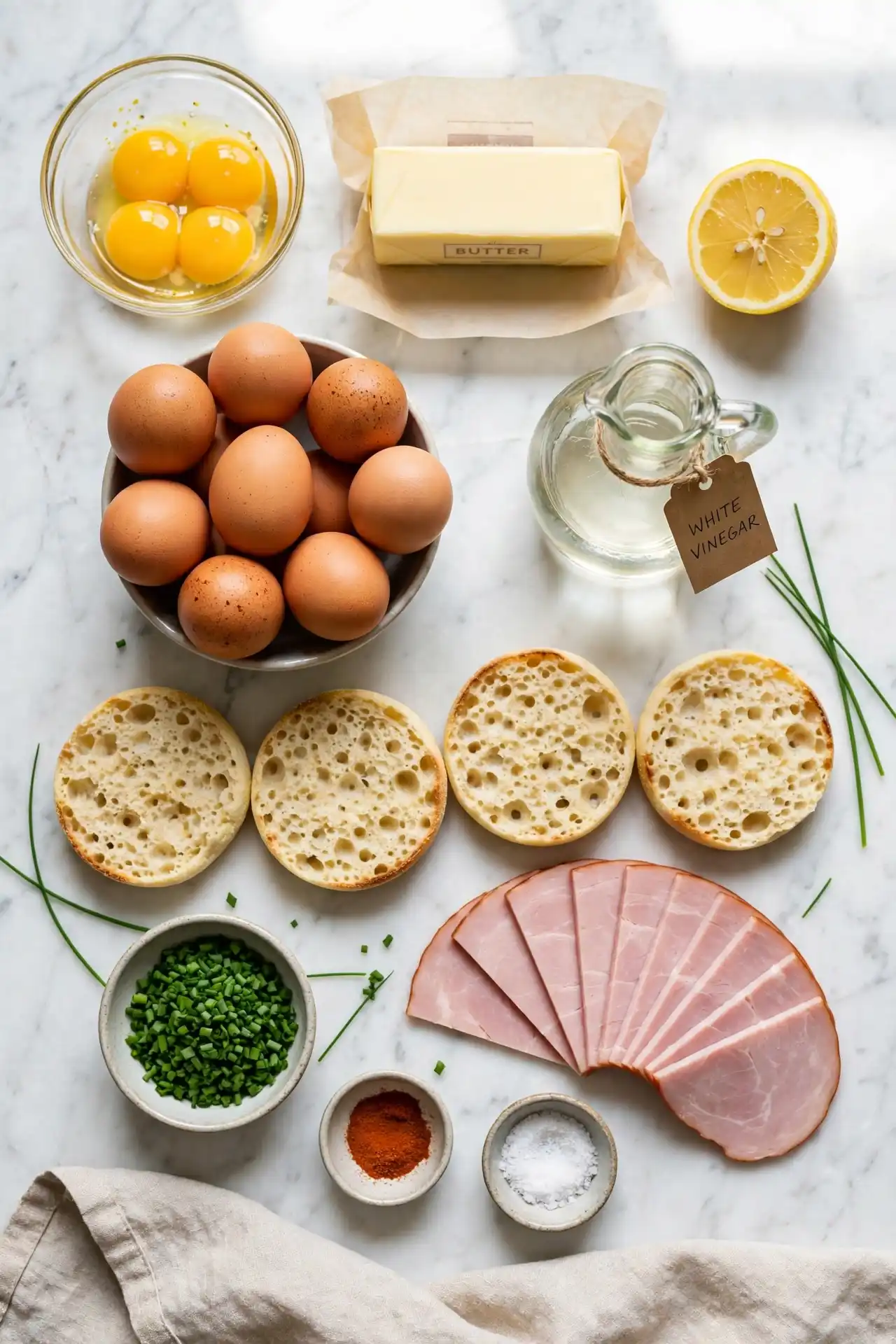
Ingredients You’ll Need
For the Hollandaise Sauce
- 3 large egg yolks, room temperature — the base of the emulsion; fresher eggs give a richer result
- 1 tbsp cold water — slows the cooking so yolks thicken gradually without scrambling
- 225g (1 cup / 2 sticks) unsalted butter — clarified; removing the milk solids prevents the sauce from breaking under heat
- 1 tbsp fresh lemon juice — brightens the sauce and cuts through the fat
- Pinch of cayenne pepper — adds a low background heat that you feel rather than taste
- Salt, to taste
For the Poached Eggs
- 8 large eggs, as fresh as possible — fresh eggs have thicker whites that hold their shape in the poaching water; older eggs spread and fray
- 1 litre (4 cups) water
- 2 tbsp white wine vinegar — lowers the pH so whites set faster with less feathering
For Assembly
- 4 English muffins, split — the rough, nook-and-cranny surface grips the egg and sauce better than sliced bread
- 8 slices Canadian bacon (back bacon) — lightly cured, leaner than streaky bacon, and it crisps at the edges in about 90 seconds
Recipe Timing
| Timing Element | Duration |
|---|---|
| Prep Time | 15 minutes |
| Cook Time | 20 minutes |
| Total Time | 35 minutes |
Servings: 4 | Difficulty: Medium | Cuisine: American / French | Course: Breakfast / Brunch
How to Make Eggs Benedict — Step by Step
Make the Hollandaise Sauce
Step 1: Clarify the butter
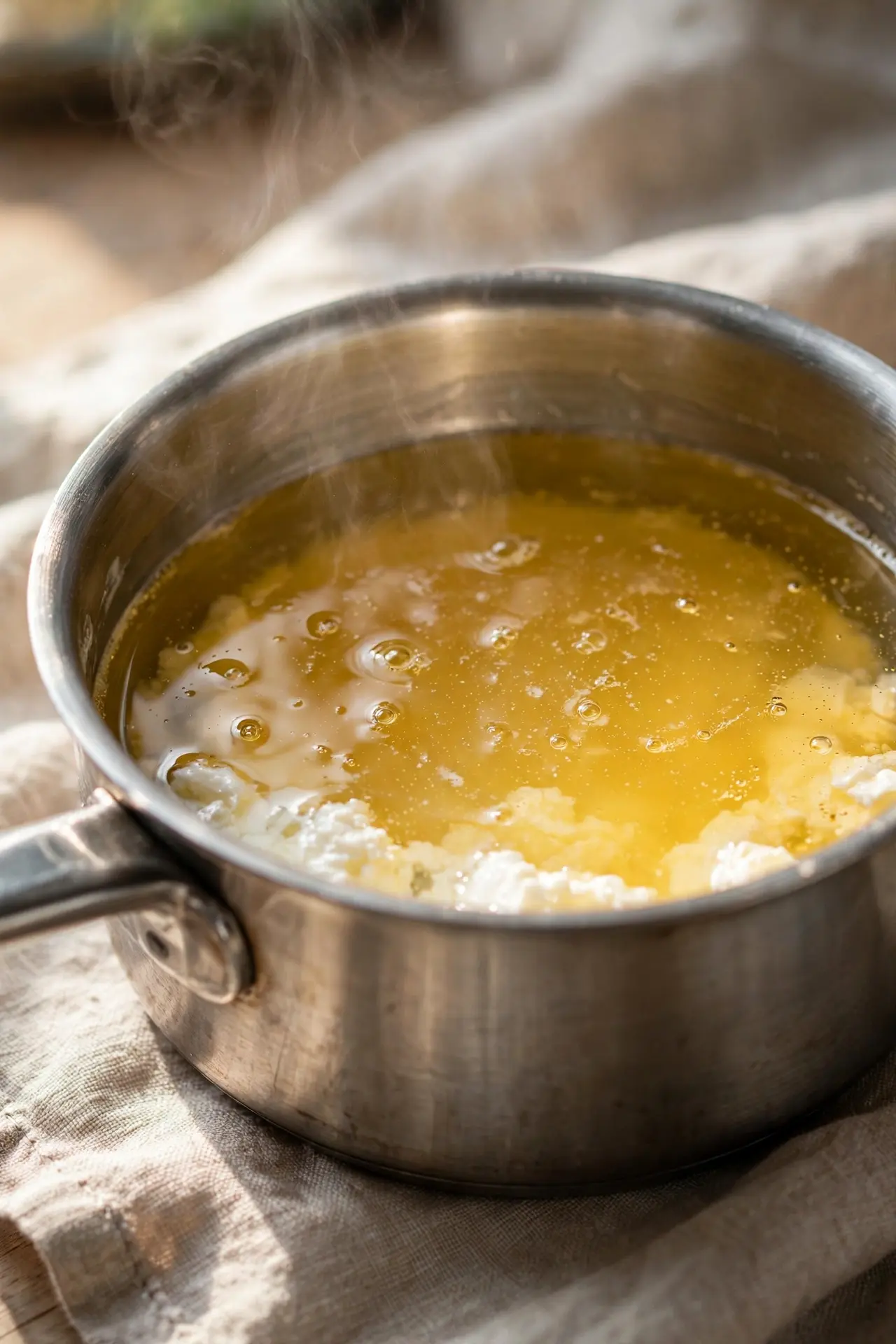
Melt 225g unsalted butter in a small saucepan over low heat. Once it’s fully melted, skim the white foam off the surface with a spoon. Slowly pour the clear golden liquid into a separate heatproof jug, leaving the milky white solids settled at the bottom of the pan.
Why this works: Milk solids contain water and proteins that cause sauces to seize and break when heated. Clarified butter is pure fat, which produces a more stable and longer-lasting hollandaise.
Step 2: Whisk the egg yolks
Place 3 egg yolks and 1 tablespoon cold water in a heatproof bowl. Set the bowl over a pot of barely simmering water, making sure the base of the bowl doesn’t touch the water surface. Whisk constantly for 3 to 4 minutes until the mixture turns pale yellow, thickens considerably, and has roughly tripled in volume. When you lift the whisk, the mixture should fall in thick ribbons that hold their shape for 2 to 3 seconds before dissolving back in.
⚠️ Food Safety: Keep the water at a gentle simmer throughout, not a boil. Egg yolks need to reach 63°C (145°F) to be safe. If you have an instant-read thermometer, use it here. The FDA’s egg safety guidelines recommend this temperature for partially cooked egg preparations.
Step 3: Emulsify with the clarified butter
Remove the bowl from the heat. With one hand whisking steadily, begin adding the warm clarified butter a few drops at a time. After the first 3 to 4 tablespoons are incorporated and the mixture looks visibly thick and glossy, increase to a thin, steady stream. Continue until all the butter is in. Whisk in 1 tablespoon of fresh lemon juice and the pinch of cayenne, then taste for salt.
Why this works: Adding butter in small amounts first gives the lecithin in the egg yolks time to coat each fat droplet and hold it in suspension. Pour it in too fast and the droplets clump together, the emulsion breaks apart, and you’re left with a greasy puddle with scrambled streaks.
Step 4: Hold the sauce warm
Set the bowl back over the pot of warm water with the heat switched off. Whisk every few minutes. The hollandaise holds well at this temperature for 30 to 40 minutes without breaking or thickening too much.
Poach the Eggs
Step 5: Set up the poaching water
Fill a wide, deep saucepan with 1 litre of water and add 2 tablespoons of white wine vinegar. Bring it to a simmer over medium heat, aiming for 82 to 85°C (180 to 185°F). You want movement in the water and occasional bubbles rising from the base, but no rolling boil.
Why this works: Vinegar lowers the pH of the water, which causes egg white proteins to coagulate about 15 seconds faster than in plain water. This is the difference between a neat, tight poached egg and one with ragged, trailing wisps.

Step 6: Crack and slide each egg
Crack one egg into a small cup or ramekin. Stir the water gently with a spoon to create a slow circular swirl. Slide the egg from the cup into the center of the swirl. Cook for exactly 3 minutes for a runny yolk with set whites, or 3.5 minutes for a yolk that’s just starting to firm at the edges. Lift out with a slotted spoon and rest it on a folded kitchen towel for 10 seconds to drain the water.
⚠️ Food Safety: Use the freshest eggs you can find, since fresh eggs have thicker albumen that holds together better in hot water. For pregnant women, elderly individuals, or anyone immunocompromised, cook the yolk until fully firm rather than runny.
Step 7: Poach in batches
Work in batches of 2 to 3 eggs at a time. Since you’re making eggs benedict for 4 people, you have 8 eggs to get through. Keep the finished ones in a bowl of warm (not hot) water while you complete the rest. They hold there for up to 10 minutes without overcooking.
Assemble and Serve
Step 8: Cook the Canadian bacon
Heat a non-stick skillet over medium-high heat. Add 8 slices of Canadian bacon in a single layer. Cook 1 to 2 minutes per side until the edges brown lightly and the surface is heated all the way through. Set aside on the same kitchen towel as the eggs.
Step 9: Toast the English muffins
Split all 4 muffins and toast them cut-side down in the same skillet, or under a broiler, for about 2 minutes until golden. The toasted surface keeps the base from going soggy once the egg sits on top.
Step 10: Build each plate
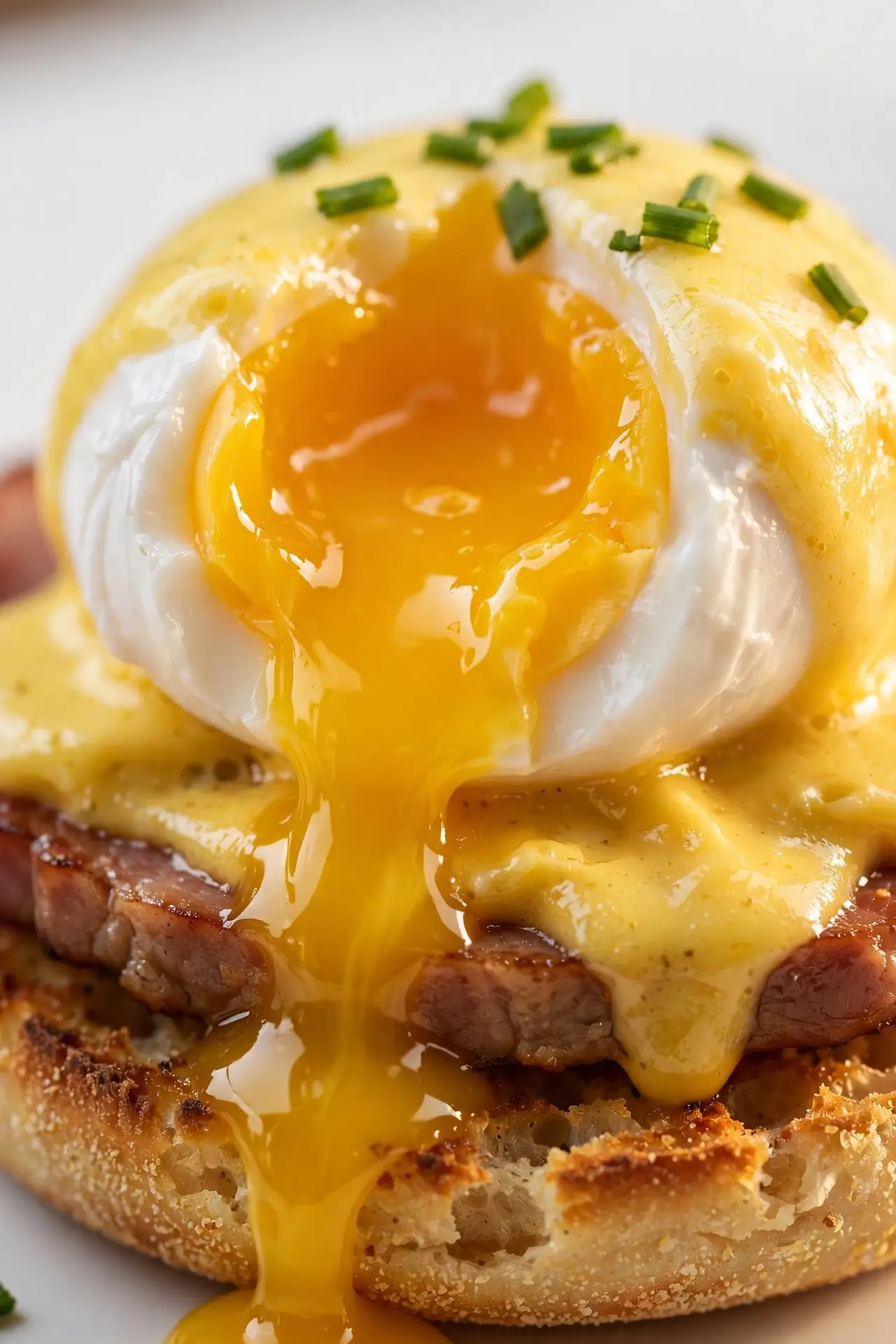
Place two muffin halves on each plate. Set a slice of Canadian bacon on each half. Lift a poached egg from the warm water with a slotted spoon, let it drain briefly, and rest it on the bacon. Spoon 2 to 3 tablespoons of hollandaise over each egg. Add a pinch of paprika and a few snipped chives to finish. Serve immediately.
Why this works: The sequence matters. Muffin first so the base stays crisp, bacon next to create a flat resting surface, egg on top so the yolk doesn’t get crushed during plating, hollandaise last so it runs naturally over everything rather than getting trapped underneath.

Common Mistakes to Avoid
Breaking the hollandaise
It happens when the butter goes in too fast or the heat under the bowl climbs too high. If you see the sauce starting to look oily and separated, take the bowl off the heat immediately, add 1 teaspoon of cold water, and whisk hard. Catch it early and it usually comes back. If it’s fully broken, start a fresh yolk in a clean bowl and slowly drizzle the broken sauce into it while whisking.
Boiling the poaching water
A rolling boil tears egg whites apart before they have a chance to set around the yolk. If the water gets too aggressive, pull the pan off the heat for a minute and let it settle back to a simmer before the next egg goes in.
Skipping the drain step
Putting a wet egg directly onto the toasted muffin drives water into the bread and turns the base soft within seconds. Ten seconds on a kitchen towel before plating keeps it crisp.
Working with cold components
Canadian bacon straight from the fridge, set on cold toast, under a barely warm egg, means the hollandaise cools and congeals before the first bite. Keep everything warm and move through the assembly quickly. All four components should hit the plate within 3 minutes of each other.
Variations & Substitutions
Eggs Florentine
Replace the Canadian bacon with a small handful of wilted spinach, squeezed as dry as you can get it. The rest of the recipe stays identical. The slight bitterness of the spinach works particularly well against the richness of the hollandaise.
Smoked salmon
Lay 2 slices of cold-smoked salmon on each muffin half in place of the bacon. Skip the cooking step entirely for the protein. A few capers scattered on the plate work better than chives here.
Regular back bacon or thick-cut ham
Canadian bacon is the traditional choice, but a thick slice of good cooked ham or a crispy rasher of back bacon both work. Back bacon gives a sharper, smokier result if that’s what you’re after.
What to Serve With Eggs Benedict
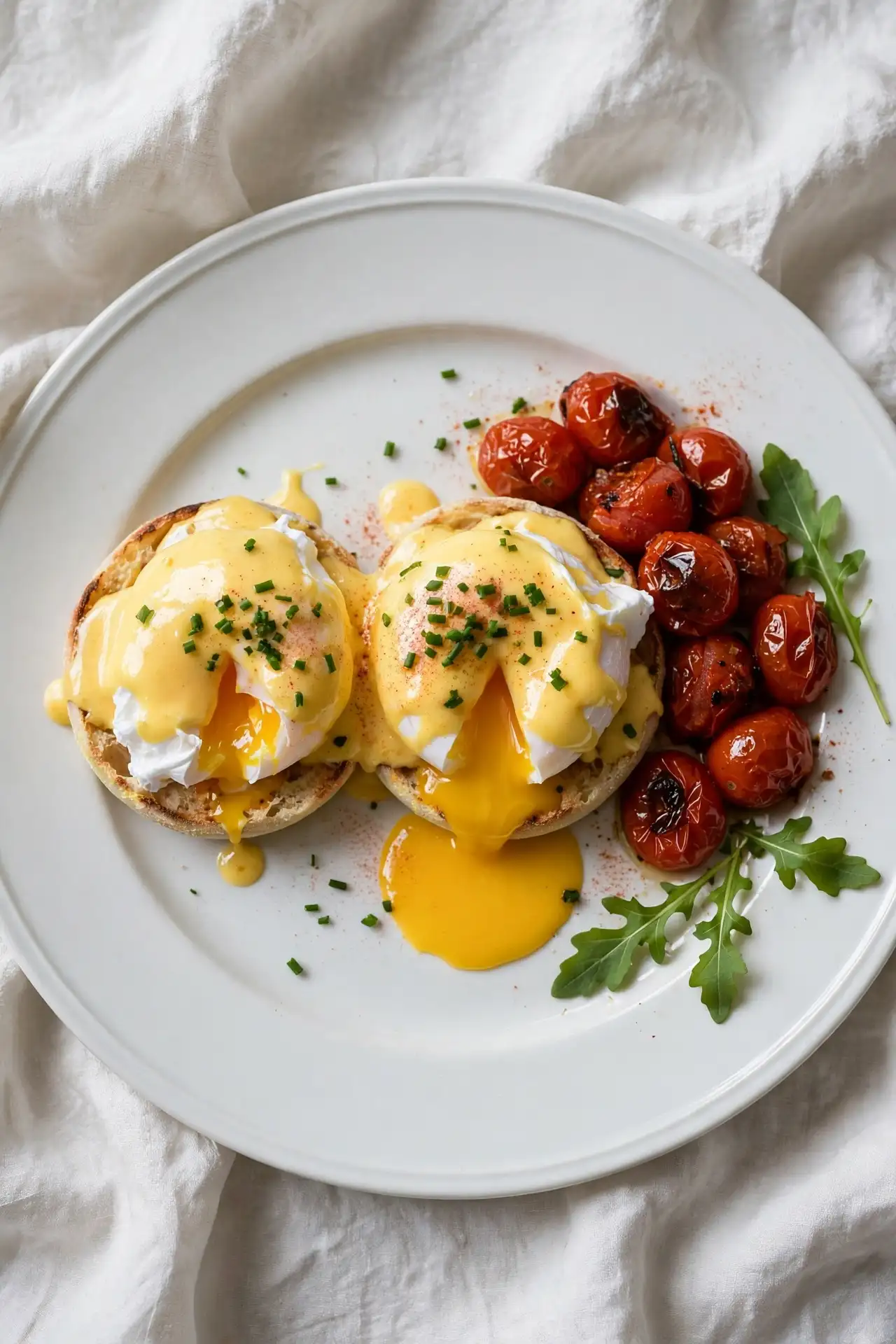
Roasted cherry tomatoes — the acidity cuts through the hollandaise and resets the palate between bites. Roast at 200°C (400°F) for 15 minutes while everything else comes together.
Hash browns or home fries — a crisp potato side is the most natural partner for this dish, giving textural contrast to the soft components on the plate.
Fresh orange juice — pairs well with a brunch spread and doesn’t compete with anything on the plate.
Peppery arugula salad — dressed with just lemon juice and olive oil, it echoes the brightness of the sauce without duplicating the richness.
Fresh fruit — keeps the overall plate feeling balanced rather than heavy, especially when serving a crowd.
Storage, Reheating & Make-Ahead
Hollandaise sauce doesn’t store safely. Make it fresh and use it within 40 minutes. If it thickens as it sits over the warm water, whisk in a few drops of warm water to loosen it. Do not refrigerate and reheat.
Poached eggs can be made up to 24 hours ahead. After cooking, transfer them directly to a bowl of ice water to stop cooking. Store in the fridge submerged in cold water. To reheat, slide the eggs into hot (not simmering) water for 60 seconds before plating.
Canadian bacon keeps refrigerated in an airtight container for up to 5 days. Reheat in a dry skillet over medium-high heat for 1 minute per side.
English muffins are best toasted fresh. Pre-toasting and storing them makes the surface chewy rather than crisp by the time you assemble.
Make-ahead brunch strategy: Poach the eggs the day before. Cook the bacon in advance and keep it refrigerated. On the day, make the hollandaise first, then reheat the bacon and eggs while the muffins toast. Assembly takes under 5 minutes.
Allergen & Dietary Information
Contains eggs. Both the hollandaise and the poached eggs are egg-based. There is no viable substitute here since eggs are the structural foundation of the dish.
Contains gluten. English muffins are made with wheat flour. For a gluten-free version, substitute certified gluten-free English muffins or use thick slices of gluten-free sourdough toast.
Contains dairy. The hollandaise requires butter. To make a dairy-free version, try clarified coconut oil in place of the butter, added using the same slow-drizzle method. The flavor will differ, but the emulsification technique stays the same.
Nutrition Information
Per serving (2 assembled halves)
| Nutrient | Per Serving |
|---|---|
| Calories | 648 kcal |
| Protein | 28 g |
| Total Carbohydrates | 29 g |
| Dietary Fiber | 2 g |
| Total Sugars | 3 g |
| Total Fat | 47 g |
| Saturated Fat | 23 g |
| Sodium | 975 mg |
| Cholesterol | 485 mg |
| Potassium | 418 mg |
| Calcium | 92 mg |
| Iron | 3 mg |
Nutritional values are estimates only and may vary based on specific ingredients, brands, and portion sizes used. For precise dietary needs, consult a registered dietitian.
Frequently Asked Questions
Why does my hollandaise sauce break, and can I fix it?
Hollandaise breaks when butter goes in too fast or the heat climbs too high, causing the fat and water to separate. If it happens, remove the bowl immediately, add 1 teaspoon of cold water, and whisk hard off any heat. If it doesn’t come back together, start a fresh egg yolk in a clean bowl and slowly pour the broken sauce in while whisking. That usually rescues it.
Can I make eggs benedict ahead of time for a brunch party?
Yes, with one exception: the hollandaise. Poach the eggs up to 24 hours ahead and store them in cold water in the fridge. Cook the bacon in advance. On the day, make the hollandaise while the muffins toast, then reheat the eggs in hot water for 60 seconds. Everything except the sauce can be prepped the day before.
Can I use regular bacon instead of Canadian bacon?
Yes. Regular back bacon, thick-cut streaky bacon, or a good slice of cooked ham all work. Canadian bacon is leaner and softer; streaky bacon gives a crispier, fattier result. The choice comes down to what texture you want under the egg.
How do I know when a poached egg is done?
Lift it out at 3 minutes and press the white gently with your fingertip. The white should feel set and firm while the yolk underneath feels soft and slightly loose. If everything feels firm, the yolk has gone past runny. If the white still feels gelatinous or tears when you press it, give it another 30 seconds.
What’s the difference between eggs benedict and eggs florentine?
The only difference is the protein. Eggs benedict uses Canadian bacon; eggs florentine replaces it with wilted spinach. The poached egg, hollandaise, and English muffin stay the same in both versions.
How do you keep hollandaise warm while you finish the eggs?
Set the bowl back over the pot of hot water with the heat off. The residual warmth keeps the sauce at a good temperature for 30 to 40 minutes. Whisk it every few minutes. If it starts to thicken, add a few drops of warm water and whisk to loosen it. According to Serious Eats’ guide to egg-based sauces, maintaining the sauce between 55 and 65°C is the safe holding window for texture and food safety.
What if my poached eggs come out with ragged, trailing whites?
Two things cause this: water that’s too hot, or eggs that aren’t fresh. Older eggs have thinner, runnier whites that spread before they can set. Use the freshest eggs available, keep the water at a lazy simmer rather than a boil, and use the gentle swirl technique described in Step 6. The vinegar helps significantly.
Conclusion
Eggs benedict rewards patience more than skill. The hollandaise asks you to go slowly, control the heat, and add the butter in stages. The poached eggs ask you to pay attention to timing. Once you’ve done both, you’ll understand exactly what you’re doing and why, which is what makes this a recipe you can repeat without following instructions. Four components, one clear sequence, and a result that most people only expect from a restaurant.
Eggs Benedict — Recipe Card
Classic Eggs Benedict with Hollandaise Sauce
Ingredients
Method
- Melt 225g butter over low heat. Skim the foam from the surface. Pour the clear golden liquid into a separate jug, leaving the milk solids in the pan.
- Whisk 3 egg yolks and 1 tbsp cold water in a heatproof bowl over barely simmering water for 3 to 4 minutes until pale, thick, and tripled in volume.
- Remove the bowl from the heat. Drizzle in the clarified butter drop by drop while whisking, increasing to a thin stream once the sauce is visibly thick. Add lemon juice, cayenne, and salt.
- Set the bowl back over warm water off the heat. Whisk occasionally to keep it smooth.
- Bring 1 litre water and 2 tbsp white wine vinegar to a gentle simmer (82 to 85°C / 180 to 185°F).
- Crack each egg into a cup. Create a gentle swirl in the water. Slide the egg into the center and cook 3 minutes for a runny yolk. Drain on a kitchen towel. Work in batches of 2 to 3.
- Cook Canadian bacon in a skillet over medium-high heat, 1 to 2 minutes per side until the edges are lightly browned.
- Toast English muffin halves cut-side down until golden, about 2 minutes.
- Assemble: muffin half, one slice Canadian bacon, one poached egg, 2 to 3 tbsp hollandaise. Finish with paprika and fresh chives. Serve immediately.